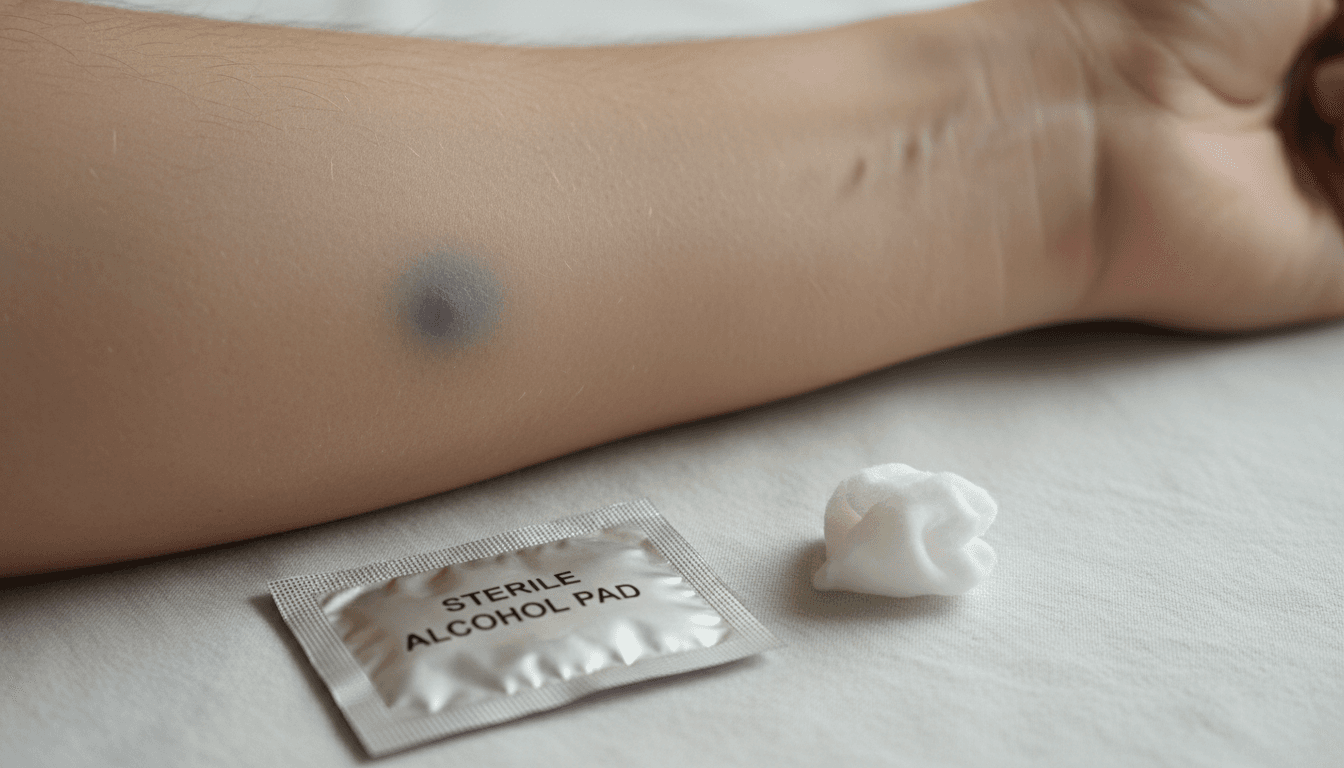
The published literature on post-injection bruising: normal versus abnormal findings, prevention per technique-literature convention, and red-flag criteria for prescriber contact. Patient-education reference. Not medical advice.
Key points
- 01Allow the antiseptic to dry fully. CDC injection-safety guidance describes allowing the alcohol prep pad to air-dry prior to insertion. Residual alcohol at the insertion point is associated with stinging and irritation in the nursing-education literature.
- 02Use a single-use needle. Needle-tip dulling with reuse is documented in Frid et al. 2016 as a contributor to tissue trauma and subsequent bruising.
- 03Apply the pinch or stretch as described for the selected needle length. Skin-pinch for short needles in lean individuals is described in Frid et al. 2016 and Perry & Potter. Correct technique reduces disruption of subcutaneous vasculature.
- 04Insert at the documented angle (90° for short needles). The 90-degree insertion convention for 4–6 mm needles is described in the published technique literature. Oblique insertion at the wrong depth contributes to capillary disruption.
- 05Depress the plunger at a steady rate. Rapid plunger depression is described in nursing-reference literature as a contributor to local tissue pressure and small-vessel disruption.
- 06Rotate sites per the three-zone protocol. FIT injection-technique recommendations describe site rotation for prevention of lipohypertrophy and vascular-site overuse.
- 07Apply gentle pressure rather than rubbing after withdrawal. Post-injection rubbing is described in nursing-education literature as increasing small-vessel trauma. Gentle pressure with a clean gauze is the described convention.
- 08Consider needle gauge. Smaller-diameter needles (higher gauge number) are associated with reduced bruising incidence in the published technique literature (Frid et al. 2016).
- 09Be aware of anticoagulant and antiplatelet medications. Aspirin, NSAIDs, warfarin, direct oral anticoagulants, and other antiplatelet or anticoagulant agents are described in general medical reference literature as increasing bruising risk. Medication management is a prescriber-directed decision.
- 10Apply cold for the first 24 hours, warmth thereafter. The cold-then-warm convention for minor soft-tissue bruising is described in general patient-education literature; it addresses local vasoconstriction followed by perfusion support during resolution.
Frequently asked questions
Is bruising after subcutaneous injection normal?+
Small, self-limited bruising after subcutaneous injection is described as common in the injection-technique literature. Frid et al. 2016 and multiple pen-manufacturer patient-information references describe its incidence as frequent and generally self-resolving within seven to ten days.
What findings warrant prescriber contact per the published guidance?+
Published nursing-reference material identifies the following as warranting contact with a prescriber: bruising accompanied by expanding redness, warmth, fever, purulent discharge, or disproportionate pain; a rapidly expanding haematoma; or bleeding that does not stop after five minutes of gentle pressure. These criteria are consistent with CDC injection-safety guidance and IDSA soft-tissue infection guidance.
Why does bruising occur?+
Capillary disruption in the subcutaneous layer at the needle track is the mechanism described in nursing-reference literature. Needle gauge, insertion speed, and rubbing after withdrawal are contributing factors.
Is NSAID use before injection described as a contributor to bruising?+
Aspirin and NSAIDs are described as antiplatelet agents in general pharmacology references, and their use is associated with increased bruising incidence in published surgical and procedural literature. Medication management is a prescriber decision.
How does bruising differ from an injection-site infection?+
Bruising is typically non-tender or mildly tender, without warmth, and without systemic signs. Cellulitis or abscess is characterized by expanding redness, warmth, fluctuance, disproportionate pain, and possible systemic signs (fever, malaise). The IDSA guidelines on soft-tissue infection describe the distinction.
What does the literature describe for care of an existing bruise?+
The general patient-education convention is cold application during the first 24 hours to reduce further extravasation, followed by warm compresses thereafter to support local perfusion and resolution. Typical resolution is described as seven to ten days.
Is lipohypertrophy related to bruising?+
Lipohypertrophy is a separate phenomenon, thickening or nodularity of subcutaneous tissue at repeatedly used sites. It is described in Frid et al. 2016 and FIT recommendations as associated with non-rotation of injection sites rather than with bruising per se.
Sources
- Frid AH et al., 2016. New Insulin Delivery Recommendations, Mayo Clinic Proceedings
- CDC. Safe Injection Practices
- Stevens DL et al., 2014. IDSA Practice Guidelines for Skin and Soft Tissue Infections
- Ozempic (semaglutide) Prescribing Information, injection-site reaction section
- Forum for Injection Technique (FIT). Injection Recommendations