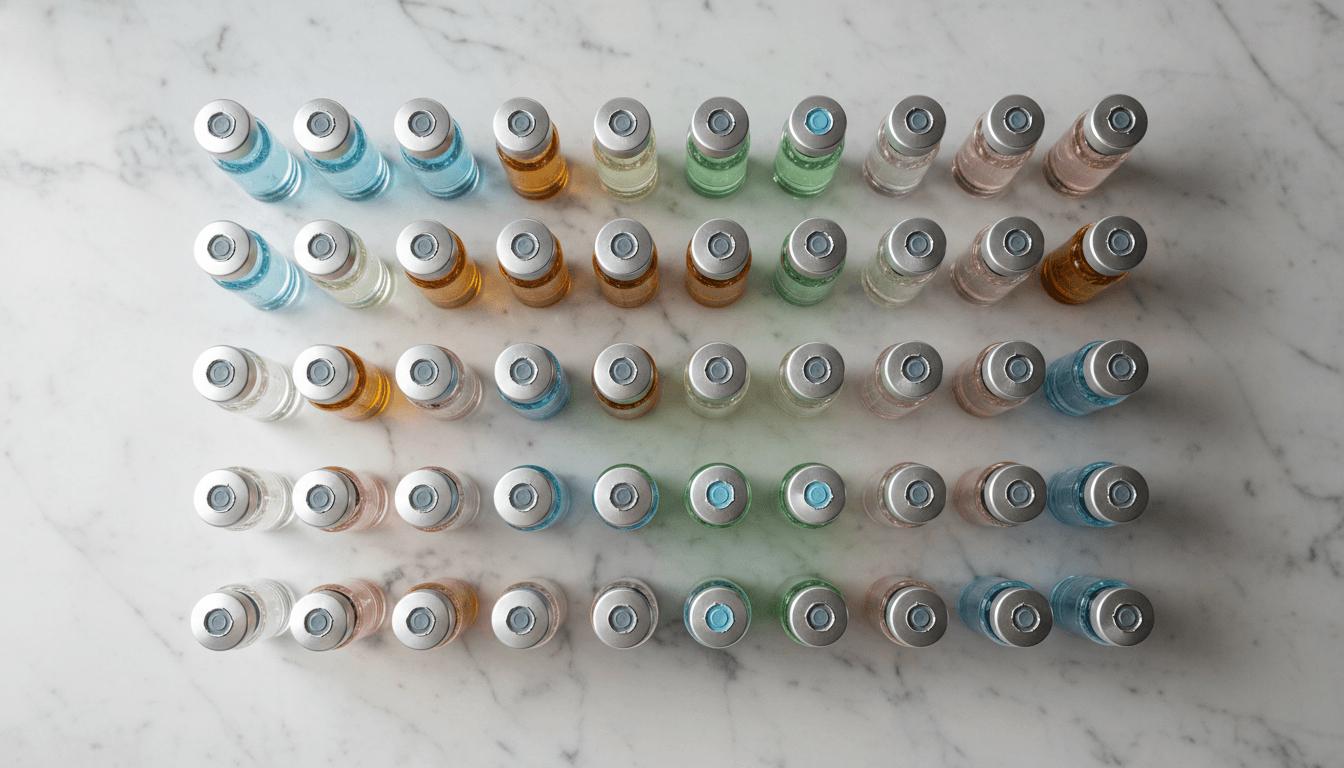
How to reconstitute GHK-Cu for research: diluent choice, concentration math, gentle mixing, and cold storage. Research use only. Not medical advice.
Key points
- 01Research-context framing applies. GHK-Cu is a copper-peptide studied in research settings, not an approved medicine. This page describes reconstitution technique for educational and research purposes only. It is not intended for human use and is not medical advice.
- 02The blue color is expected. GHK-Cu solutions are characteristically blue once dissolved because of the copper complex. A faint to distinct blue is normal, not a sign of contamination. Judge quality by clarity and the absence of particles, not by color.
- 03Pick the diluent to match your entries. Bacteriostatic water suits a vial you will enter several times; sterile water fits a single entry. Our bacteriostatic vs sterile water guide explains why the benzyl alcohol content is the deciding factor.
- 04Set concentration before mixing. Concentration is mass divided by added water. Adding 3 mL to a 50 mg vial gives about 16.7 mg per mL. Decide the target first, then let our peptide calculator convert a dose into a syringe volume.
- 05Add water on the wall and swirl to clear. Swab both stoppers, run the water gently down the inside glass, then swirl until the blue solution is uniform and clear. Do not shake; foam and shear stress serve no purpose and can degrade the peptide.
- 06Refrigerate, shield from light, label the date. Store the reconstituted vial at 2 to 8 C, keep it in the carton to limit light exposure, and write the mix date on the label. See how long a reconstituted peptide lasts for the discard window.
Frequently asked questions
Why is reconstituted GHK-Cu blue?+
The blue tint comes from the copper in the GHK-copper complex and is expected once the powder dissolves. It is not a sign of a problem. Judge the mix by clarity and the absence of particles. Research use only.
Bacteriostatic or sterile water for GHK-Cu?+
Bacteriostatic water suits a vial entered several times because its benzyl alcohol limits microbial growth; sterile water fits a single entry. See our bacteriostatic vs sterile water guide for the tradeoff.
How do I calculate the concentration?+
Divide the labeled mass by the water you add. For a 50 mg vial, 2 mL gives 25 mg per mL and 3 mL gives about 16.7 mg per mL. Fix the concentration first, then use a calculator for per-dose volume.
Is GHK-Cu an approved drug?+
No. GHK-Cu is a research copper-peptide, not an approved medicine. This page is for educational and research purposes only, is not intended for human use, and is not medical advice.